
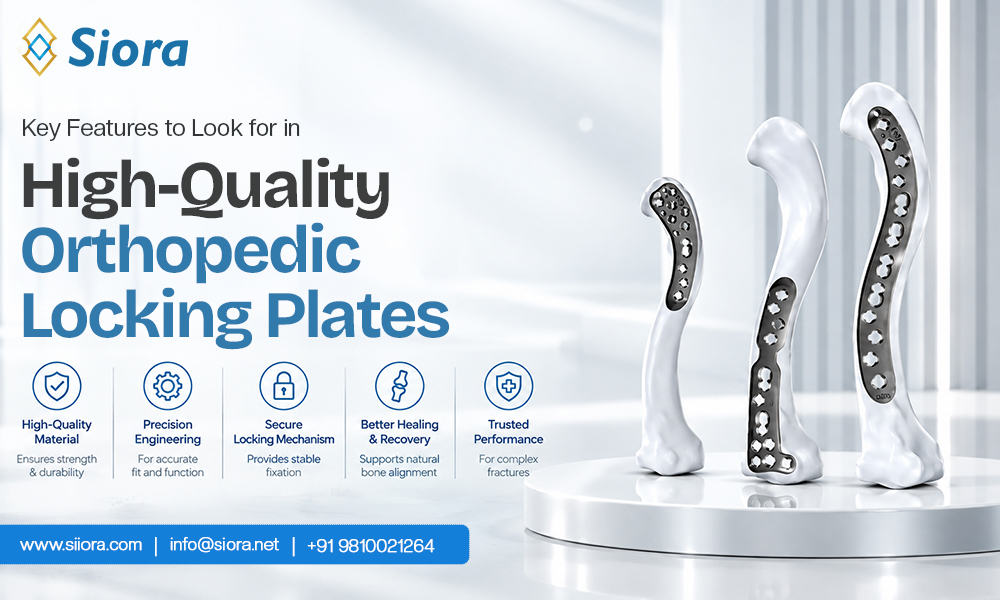
Orthopedic locking plates have changed the way many fractures are treated, particularly when stable fixation is needed in challenging bone conditions. Unlike conventional plates, locking plates allow screws to lock directly into the plate, creating a fixed-angle construct. However, not every locking plate offers the same level of performance. The design, material, manufacturing quality, and compatibility of the implant can all influence the outcome.
If you are evaluating orthopedic locking plates, here are some important features worth considering.
- Strong and Biocompatible Material
Material quality is one of the first things to examine. High-quality locking plates are commonly manufactured from implant-grade titanium alloys or stainless steel.
Titanium alloys such as Ti-6Al-4V are valued for their strength, corrosion resistance, and biocompatibility. Stainless steel, meanwhile, offers excellent mechanical strength and has a long history of use in orthopedic fixation. The selected material should comply with relevant implant material standards and be suitable for long-term implantation.
- Reliable Locking Mechanism
The locking interface is at the heart of a locking plate. A well-designed plate should provide secure engagement between the screw head and the threaded plate hole.
Proper thread geometry and accurate manufacturing tolerances help ensure that locking screws engage smoothly and remain securely seated. This fixed-angle relationship can provide angular stability and reduce the dependence of fixation on the plate being pressed tightly against the bone.
- Anatomical Contouring
A good locking plate should be designed around the anatomy it is intended to treat. Anatomically contoured plates can reduce the need for extensive intraoperative bending and help the implant sit appropriately along the bone.
This is particularly important for areas with complex anatomy, such as the distal tibia, distal femur, clavicle, proximal humerus, and periarticular regions.
- Appropriate Hole Configuration
The arrangement of screw holes deserves close attention. Depending on the fracture and surgical technique, a surgeon may need locking screws, conventional cortical screws, or a combination of both.
Modern plate systems may therefore incorporate combination holes or variable-angle technology, giving surgeons greater flexibility when positioning screws and managing different fracture patterns.
- Smooth Surface and Edge Finish
Small manufacturing details can make a significant difference. High-quality plates should have a smooth surface with properly finished edges and minimal burrs or sharp transitions.
Careful finishing supports soft-tissue management and reflects the overall precision of the manufacturing process. Consistent surface quality is especially important for implants intended for anatomically sensitive locations.
- Proven Manufacturing Quality
A sophisticated design is only useful when manufacturing consistently reproduces that design. Quality orthopedic plates should be produced under controlled manufacturing conditions with appropriate inspection and testing procedures.
Manufacturers following recognized quality management systems, such as ISO 13485, demonstrate a structured approach to medical-device quality and production control.
- Screw and Instrument Compatibility
A locking plate should work seamlessly with its designated screws and instrumentation. Clear compatibility between plates, locking screws, drill guides, and instruments can make the surgical workflow more predictable.
Choosing Quality Beyond Appearance
A high-quality orthopedic locking plate is more than a precisely shaped piece of metal. Its performance depends on material selection, locking-hole accuracy, anatomical design, surface finishing, manufacturing controls, and system compatibility.
For hospitals, surgeons, and orthopedic distributors, evaluating these factors can help distinguish a genuinely well-engineered trauma implant from one that simply looks well made. Ultimately, the right locking plate should combine dependable fixation with thoughtful design and consistent manufacturing quality.

